NIS-2 Directive: cybersecurity obligations for companies. Do you need support with implementation?More about NIS-2

Focus topic: phishing & social engineering

Phishing simulation & awareness trainingThe human as the entry point.

machCon trains your employees with realistic phishing simulations by email and via fake notifications from Teams, Zoom or Outlook. Online, GDPR-compliant, with a measurable report and as evidence for ISO 27001, NIS-2 and TISAX. For companies in Germany, Austria and Switzerland.

Animation: a school of fish representing employees swims past. An email hangs on the hook as bait. One fish bites and is pulled up. One click is enough.!One click is enough.
A phishing simulation shows who takes the bait before real phishing emails cause damage.

Free phishing test

Phishing or real?

Ten messages, one decision per card: can you spot the fakes? After each card you see how to recognise it.

About 3 minutes, no sign-up, no data is stored.

Start the phishing test

Basics

What is a phishing simulation?

A phishing simulation is a controlled test in which employees receive realistic but harmless phishing messages. It measures how many click or enter data, so that training can focus where it makes the biggest difference.

84%

of companies in Germany affected by a cyberattack were attacked with phishing.

Source: TÜV Cybersecurity Studie 2025. Spam filters catch a lot, but in the end people decide.

How a simulation works

  1. The test email arrives

    A supposed invoice, parcel notification or Teams message. Deceptively real, tailored to your company, but completely harmless.

  2. Employees respond

    Just like in everyday work: some spot the fake, others click the link or enter data on a replica page.

  3. A learning moment, not damage

    Anyone who clicks learns straight away that it was a test and how the email could have been recognised. No real data leaves the company.

  4. The evaluation shows the way

    Click rates by department and attack wave show where training makes the biggest difference, and whether it works.

How to recognise phishing

  1. Check the sender address

    The name sounds familiar, but the domain behind it does not belong to your company.

  2. Time pressure and threats

    “Urgent”, “today”, “or you will be blocked”: pressure is meant to stop you from thinking.

  3. Check the link before clicking

    Hover over the button: does it lead to an unfamiliar site that asks for login details?

  4. Unexpected attachments

    Double extensions such as “.pdf.html” or Office files with macros are a clear warning sign.

Think you know your stuff?Test your knowledge in about 3 minutes.
Start the phishing test

What is phishing?

Phishing is a type of fraud in which criminals try to obtain confidential information such as passwords, credit card details or login credentials for company systems. The messages look deceptively real, for example like communications from banks, well-known online services or colleagues.

Types of phishing at a glance

What is social engineering?

Social engineering refers to attacks in which perpetrators deliberately manipulate people, for example through time pressure, feigned authority or helpfulness. The aim is to get someone to disclose data, approve a payment or open malware. Phishing is the most common form of social engineering.

Types of phishing

What types of phishing are there?

Phishing comes as mass email, as a targeted attack on individuals or management, via QR codes, collaboration platforms, SMS and phone. AI is increasingly involved. The overview shows which variants we recreate in the simulation and which are covered in training.

Types of phishing with channel, example and coverage in the machCon phishing simulation
Type of attackChannelTypical exampleIn our simulation
Email phishingEmail to many recipientsFake parcel notification or a warning that your password is about to expire
Simulated
Spear phishingPersonal emailEmail with a real name, an ongoing project or a manager as the sender
Simulated
WhalingEmail to executivesTargeted attack on the managing director or head of finance, for example with a supposed contract request
Simulated
CEO fraudBusiness email compromiseEmailThe supposed managing director asks for an urgent, confidential bank transfer
Simulated
QuishingQR code in email or PDFQR code supposedly to renew two-factor sign-in. It is scanned with a phone, where no company filter applies
Simulated
Platform phishingTeams, Zoom, Outlook, WebEx, Citrix, Google MeetFake meeting invitation or file share that asks you to sign in
Simulated
AI-assisted phishingEmail, phone, videoFlawless, personally tailored emails or the cloned voice of the managing director on the phone
AI emails simulatedDeepfakes in training
SmishingSMS and messengersSupposed delivery notification with a tracking link
Covered in training
VishingPhoneCaller poses as IT support or the bank and asks for login details
Covered in training

Our services

Phishing simulation & awareness

We test your employees with realistic attacks, train them in a practical way and show you with numbers how your organisation improves.

Core service

Phishing simulations with reporting

Controlled, realistic phishing attacks by email and via fake platform notifications, tailored to your company and your timeline. After each attack wave you receive a report with click rates, departmental comparisons and concrete recommendations for action.

  • Four attack waves
  • Fully online
  • GDPR-compliant
  • Evidence for audits
Request a simulation
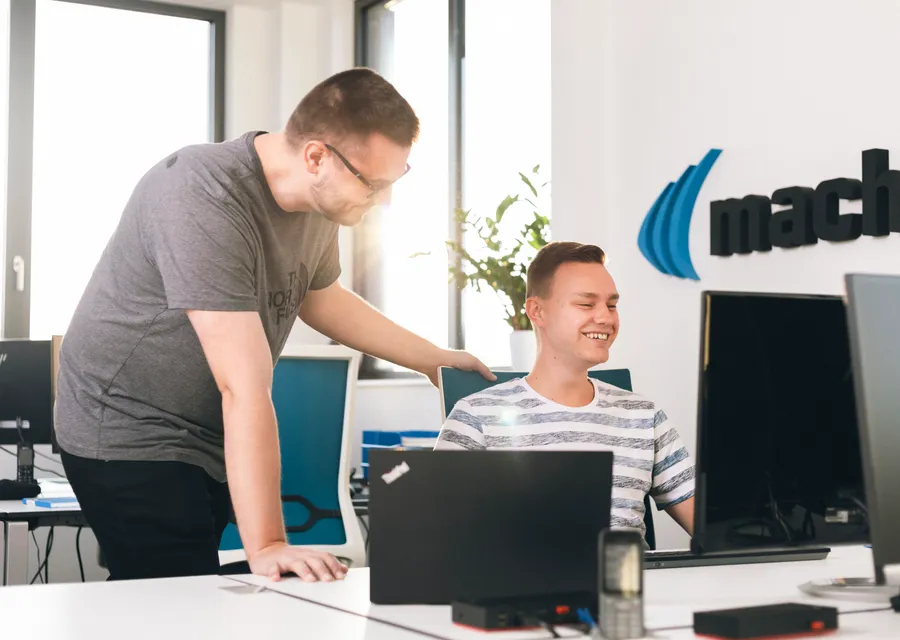
Two machCon consultants working together at a screen
  • Awareness training

    Practical training for all employees, online or additionally on site if you wish. Your team learns to recognise phishing and to report suspicious messages to IT correctly.

  • E-learning modules

    Scalable online modules for the entire organisation. Flexible timing, short units and documented completion.

  • Spear phishing and whaling

    Targeted tests using personal information, also at management level, for example with fake payment orders in the name of the managing director.

  • Management training

    NIS-⁠2 obliges management to complete its own training. We train managing directors and executives concisely on risks, duties and liability.

    To NIS-⁠2 consulting
  • Platform attacks

    Fake notifications via Microsoft Teams, Zoom, Outlook, WebEx, Citrix or Google Meet as an entry point, simulated and trained.

  • Evaluation and reporting

    Detailed reports with click rates, departmental comparisons and concrete recommendations, after each wave and as a final report.

  • Repeat cycles

    Continuous awareness programmes throughout the year. Security comes from regular training, not from a one-off campaign.

  • Part of your ISMS

    Awareness is a requirement of ISO 27001 and NIS-⁠2. We document simulations and training so that they serve as evidence.

    To IT security consulting

Our approach

A phishing campaign in five steps

From the first conversation through four attack waves to the final report: this is how a phishing simulation with machCon works, and what you have in hand after each step.

  1. Free initial consultation

    30 minutes, non-binding, on site or remote. We clarify goals, company size and starting point.

    ResultYour individual offer

  2. Initialisation

    Together we define scope, scenarios and timeline. This includes alignment with data protection and, where applicable, the works council, as well as technical preparation with your IT.

    ResultAgreed campaign plan

  3. First attack waves

    Setting up the simulation infrastructure, spam tests and running the first two attack scenarios.

    ResultReporting on attacks 1 and 2

  4. Mid-point and analysis

    Status analysis at the halfway point, followed by attacks three and four. The trend comparison shows whether the training works.

    ResultIndividual reports and trend comparison

  5. Conclusion

    Overall evaluation, improvement measures and recommendations for the next year, discussed in person.

    ResultFinal report as evidence for audits

Data protection & works council

Fair to your team. Clear for management.

By default, the report shows results per department. Anyone who repeatedly stands out receives follow-up training according to rules agreed in advance and, if necessary, is reported by name. Because machCon also works as an external data protection officer, this approach is planned to be GDPR-compliant from the start and agreed with your works council.

In the report by defaultSample data

Click rate per department after attack wave 1

  • Sales21%
  • Purchasing14%
  • Accounting9%
  • Production7%
  • Administration5%

Recommendation: Train sales and purchasing specifically on invoice and supplier phishing.

Only under agreed rules

Named results for individuals

Visible only from stage 3

Train first, then escalate

A single click has no consequences. When results become visible by name is something you decide in advance with us and your works council.

  1. Stage 1

    Clicked once

    Counts anonymously in the department’s click rate. No name in the report, no consequence.

  2. Stage 2

    Clicked repeatedly

    The person receives targeted follow-up training on exactly the attack patterns they fell for.

  3. Stage 3

    Persistently at risk

    Anyone who still stands out over several waves despite follow-up training is reported to the agreed contact, for example their manager or HR.

  • Data protection from the start

    Your data protection officer is involved, the processing is documented and the data processing agreement is in place.

  • Works council on board

    We explain the goal, procedure, evaluation and stage model and help you agree on everything together.

Evaluation

What is in the report?

After each attack wave you receive a report, and a final report at the end. It shows where your organisation stands, whether the training works and what to do next.

  • Click rates per wave

    How many clicked or entered data, per scenario.

  • Departmental comparison

    Which areas are particularly at risk.

  • Trend across all waves

    Whether the click rate falls and the training works.

  • Concrete recommendations

    Which training makes the biggest difference where.

  • Evidence for audits

    Documented for ISO 27001, NIS-⁠2 and TISAX.

Final reportClick rate across four attack wavesSample data
  1. 24%
  2. 16%
  3. 11%
  4. 7%
Wave 1Wave 2Wave 3Wave 4
17 percentage pointsfewer clicks between the first and the fourth wave
Recommendations for next year
  1. Follow-up training for purchasing on fake supplier invoices
  2. Add a QR code scenario to wave 1 next year
  3. Short training for management on CEO fraud

Compliance

One step closer to certification and NIS-⁠2 compliance

Information security training is required by almost every standard and law. With a phishing simulation you not only meet this obligation, you also prove that it works.

One campaign.
Six pieces of evidence.

  • ISO 27001
  • NIS-⁠2
  • TISAX
  • GDPR
  • BSI IT-Grundschutz
  • Cyber insurance
  • ISO 27001

    Annex A 6.3
    Required
    Information security awareness, education and training for all employees.
    Your benefit
    Reports and proof of participation are audit-ready evidence for certification.
    To IT security consulting
  • NIS-⁠2

    Art. 20 and 21
    Required
    Training in cybersecurity and cyber hygiene, plus a separate training obligation for management.
    Your benefit
    Evidence for the authority and relief for management on liability issues.
    To NIS-⁠2 consulting
  • TISAX

    VDA ISA
    Required
    Employee awareness and training as an audit requirement in the assessment.
    Your benefit
    Meets a requirement that your OEM customers check in the assessment.
  • GDPR

    Art. 32 and 39
    Required
    Technical and organisational measures and staff awareness.
    Your benefit
    Fewer data breaches caused by phishing and documented measures for your TOMs.
    To data protection consulting
  • BSI IT-Grundschutz

    ORP.3
    Required
    Module “Awareness and training in information security”.
    Your benefit
    Covers the corresponding module in the IT-Grundschutz model.
  • Cyber insurance

    Risk questionnaire
    Required
    Many insurers ask in the application whether awareness measures take place regularly.
    Your benefit
    Better chances of insurability and good terms.

Training format

Train online, deepen on site if you wish

The phishing simulation and e-learning run entirely online. Classroom training at your company can simply be added.

Always included

Online

  • Phishing simulations via our platform
  • E-learning modules, flexible and with documented completion
  • Reports and evaluation meetings held remotely
Optional add-on

On site with you

  • Classroom training for teams or the whole workforce
  • Compact training for management
  • With real examples that stick

Here for you from Engen im Hegau, Zug and Basel

In person in the region and just as committed throughout Germany, Austria and Switzerland.

Engen im Hegau

Lake Constance, Hegau, Black Forest

A large part of our team works here. From here we can reach you quickly for training and workshops.

  • Singen
  • Konstanz
  • Radolfzell
  • Stockach
  • Tuttlingen
  • Villingen-Schwenningen
  • Schaffhausen

Zug

Central Switzerland

In the middle of one of Switzerland’s most important economic regions. Our consultants usually work directly at your company.

Basel

Northwestern Switzerland

Our clients come from very different industries, from pharma and life sciences to municipalities.

Why machCon

Awareness with experience

Our simulations are realistic because we know the attacks that actually hit companies. And our training works because it uses real examples instead of slides.

Meet our team
machCon consultants working together at a screen

350+

companies supported

  • Realistic scenarios

    By email and via collaboration platforms we simulate exactly the attacks that reach your employees in everyday work.

  • ISO 9001 certified

    Our internal processes are ISO 9001 certified. We attach great importance to consistently high consulting quality.

  • Dedicated contacts

    Every client has a personal main contact and a permanent deputy. On site or remote, just as you prefer.

Here for you from Engen (Hegau), Zug and BaselIn person in the region and just as committed throughout Germany, Austria and SwitzerlandWhere we are on site

A large part of our team works in Engen in the Hegau region. From here we can quickly reach companies in Singen, Konstanz, Radolfzell, Stockach, Tuttlingen, Villingen-Schwenningen or Schaffhausen, and we are happy to come to you for audits, training and workshops.

In Zug and Basel we are right in the middle of one of Switzerland’s most important business regions. Here our consultants usually work directly at your company and are firmly integrated into your projects. Our clients come from a wide range of industries, from pharma and life sciences to local authorities. We support them in a wide variety of projects and provide ongoing support for data protection, IT security and quality management.

We support clients throughout Germany, Austria and Switzerland just as reliably, with dedicated contacts, remote meetings and on-site visits whenever they are needed.

Your contacts for phishing simulations

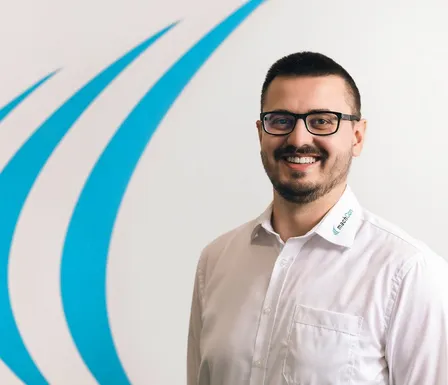
  • Zdravko Matić

    Zdravko Matić

    IT Security Consultant

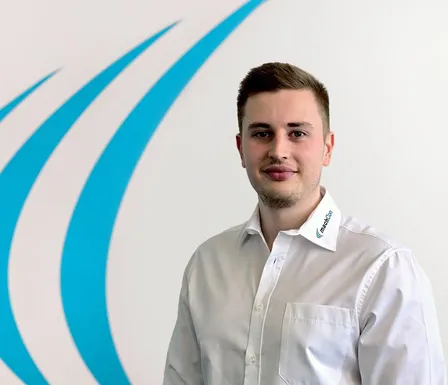
  • Stanislav Miller

    Stanislav Miller

    IT Security Consultant

Customer reviews

What clients say about our phishing simulations

Companies that have strengthened their employees’ security awareness with machCon.

“machCon’s realistic phishing tests show us where we can improve.

We value the clear evaluation and the efficient recommendations for implementation. This allows us to strengthen our employees’ security awareness in a targeted way.”

Wittmann Entsorgungswirtschaft GmbHPhishing simulations and awareness

Become our next success story

In a free 30-minute initial consultation we clarify what a phishing simulation could look like in your organisation.

Book initial consultation

“Thanks to machCon’s professional phishing simulation, we raise our employees’ awareness of cyber risks in a targeted way. The practical tips help us strengthen security awareness for the long term.”

Renfert GmbHPhishing simulations and awareness

“With machCon’s phishing simulation we are noticeably raising our level of security. The practical support makes awareness tangible and lasting, and helps us identify risks early.”

Hörwelt Jana RitterPhishing simulations and awareness

Related services

Awareness is part of the bigger picture

These topics complement your phishing prevention and can be implemented with us from a single source.

  • NIS-⁠2 compliance

    Training and awareness are mandatory under NIS-⁠2. We implement all requirements with you.

    To NIS-⁠2 consulting
  • AI compliance

    Train AI literacy and use AI tools safely, including protection against AI-assisted phishing.

    To AI compliance

FAQ

Questions and answers on phishing simulations

The most important answers on procedure, costs, data protection and training.

Your question is not listed?

In a free 30-minute initial consultation we answer your questions personally, on site or remote.

Book initial consultation

Why are technical protective measures not enough?

Spam filters and antivirus software catch a lot, but not everything. According to the TÜV Cybersecurity Studie 2025, 84% of companies in Germany affected by a cyberattack were attacked with phishing, and the Verizon Data Breach Investigations Report 2026 also sees people as a frequent starting point for data breaches. Your employees’ judgement is the last line of defence, and it can be trained.

Which types of phishing does machCon simulate?

We simulate email phishing, spear phishing, whaling, CEO fraud, quishing via QR code and fake notifications from Teams, Zoom, Outlook, WebEx, Citrix or Google Meet. We cover smishing via SMS, vishing by phone and deepfake calls in our awareness training.

How does a phishing simulation work?

In five steps: after the free initial consultation we define scope, scenarios and timeline and align data protection, the works council and technology. Then come the first two attack waves, a mid-point analysis, attacks three and four with a trend comparison and finally a report with an overall evaluation and recommendations.

What is in the report?

Click rates per wave, departmental comparisons, the trend across all attack waves and concrete recommendations for action. So you can see where your organisation stands, whether the training works and where training makes the biggest difference.

How much does a phishing simulation cost?

The cost depends on the number of employees, the number of attack waves and the training you want. In a free 30-minute initial consultation we clarify your needs, after which you receive an individual offer.

Is a phishing simulation GDPR-compliant?

Yes, if it is planned properly. By default we evaluate at department level. Named results are only available under rules agreed in advance. Your data protection officer is involved, the processing is documented and data processing is governed by contract.

Does the works council have to agree?

In Germany usually yes, as soon as results can be attributed to individual employees. In Austria consent may be required; in Switzerland there is no co-determination as in Germany, but there is a duty of transparency. We support you in reaching agreement.

Are employees informed in advance?

As a rule, staff are informed in advance that phishing simulations will take place, but not when or with which messages. We agree the exact approach with you during initialisation.

What happens if someone clicks?

A single click counts anonymously in the department’s click rate. Anyone who clicks repeatedly receives targeted follow-up training. Anyone who still stands out over several waves is reported to the responsible contact according to rules agreed in advance.

How often should we test and train?

Security comes from regular training. We recommend continuous awareness programmes throughout the year instead of a one-off campaign, with recurring simulations and training.

Is it worthwhile for small companies too?

Yes. Attackers do not distinguish by company size. Our clients include small specialist businesses as well as medium-sized companies, and we adapt scope and scenarios to your size.

Does the training take place on site or online?

Phishing simulations and e-learning run entirely online. In addition, we offer classroom training at your company, particularly quickly from Engen, Zug and Basel.

What should I do if I have clicked on a real phishing link?

Do not enter any further data and inform your IT department or IT service provider immediately. If you entered a password, change it straight away from another device. Report the incident even if you are unsure: the sooner IT responds, the smaller the damage.

Train your team before attackers test it.

Book your free 30-minute initial consultation and find out how a phishing simulation at machCon works.